

 Preservatives(food)
 Flavor Enhancers
 Acidulants
 Sweeteners
 Antioxidants
 Colorants(food)
 Nutraceutical Ingredients (food)
 Nutrient Supplements
 Emulsifiers
 Collectors
 Dust Suppressants
 Explosives and Blasting Agents
 Flocculants and Coagulants
 Frothers
 Leaching Agents
 pH Modifiers
 Precious Metal Extraction Agents
 Antioxidants(plastic)
 Colorants (Pigments, Dyes)
 Fillers and Reinforcements
 Flame Retardants
 Monomers
 Plasticizers
 Polymerization Initiators
 Stabilizers (UV, Heat)
 Antifoaming Agents
 Chelating Agents
 Coagulants and Flocculants
 Corrosion Inhibitors
 Disinfectants and Biocides
 Oxidizing Agents
 pH Adjusters
 Scale Inhibitors( water)
 Antioxidants(cosmetic)
 Emollients
 Fragrances and Essential Oils
 Humectants
 Preservatives
 Surfactants(cosmetic)
 Thickeners
 UV Filters
 Fertilizers
 Soil Conditioners
 Plant Growth Regulators
 Animal Feed Additives
 Biostimulants
 Pesticides (Herbicides, Insecticides, Fungicides)
 Active Pharmaceutical Ingredients (APIs)
 Excipients
 Solvents(pharmaceutical)
 Antibiotics
 Antiseptics and Disinfectants
 Vaccine Adjuvants
 Nutraceutical Ingredients (pharmaceutical)
 Analgesics & Antipyretics
 Analytical Reagents
 Solvents(lab)
 Chromatography Chemicals
 Spectroscopy Reagents
 microbiology-and-cell-culture-reagents
 Molecular Biology Reagents
 Biochemical Reagents
 Inorganic and Organic Standards
 Laboratory Safety Chemicals
 Specialty Laboratory Chemicals(Special Laboratory Equipment)
 Demulsifiers
 Hydraulic Fracturing Fluids
 Scale Inhibitors(oil)
 Surfactants(oil)
 Drilling Fluids
 Dyes and Pigments
 Bleaching Agents
 Softening Agents
 Finishing Agents
 Antistatic Agents
 Admixtures
 Waterproofing Agents
 Sealants and Adhesives
 Curing Compounds
 Concrete Repair Chemicals
 Anti-Corrosion Coatings
 Surfactants(cleaning)
 Builders
 Enzymes
 Solvents (Cleaning)
 Fragrances
 Electronic Chemicals
 Catalysts
 Lubricants
 Photographic Chemicals
 Refrigerants
 Automotive chemicals
 Pyrotechnic Chemicals
 Biodegradable Surfactants
 Bio-based Solvents
 Renewable Polymers
 Carbon Capture Chemicals
 Wastewater Treatment Chemicals
 Pigments
 Solvents(paint)
 Specialty Coatings
 Binders/Resins
 Additives
 Driers
 Anti-Corrosion Agents
 Functional Coatings
 Application-Specific Coatings
 Leavening Agents
 Dough Conditioners
 Flour Treatments
 Fat Replacers
 Decoratives
 Preservatives(baking)
 Plasticizers & Softeners
 Reinforcing Agents
 Adhesion Promoters
 Vulcanizing Agents
 Antidegradants
 Blowing Agents
 Fillers & Extenders
 Accelerators & Retarders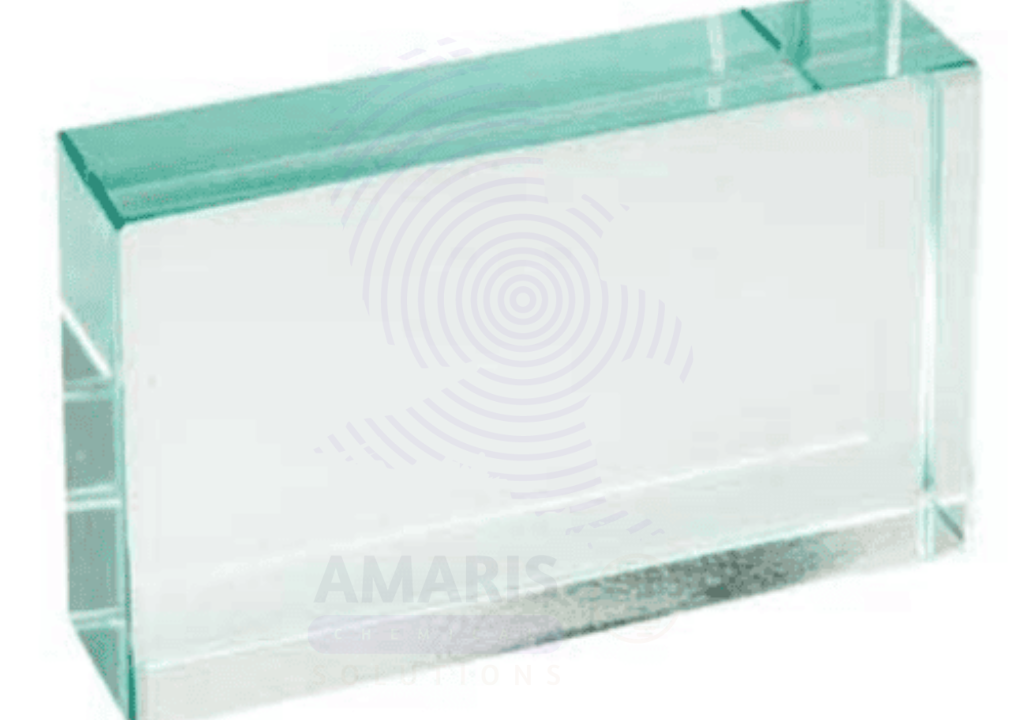

Rectangular Glass Block
Rectangular Glass Block is a precisely manufactured optical glass apparatus commonly used in physics and optics laboratories. It serves as a medium for experiments involving light refraction, reflection, and dispersion. The block’s uniform rectangular shape and polished surfaces provide clear, distortion-free passage of light, making it ideal for studying phenomena such as critical angle, total internal reflection, and lens behavior. Made from high-quality, optically clear glass, this block withstands repeated handling and laboratory conditions. It is essential for educational demonstrations and research in geometric optics and photonics.
Rectangular Glass Block
Primary Uses
- Laboratory Applications
- Used in optics experiments to demonstrate refraction and reflection of light.
- Employed to study the critical angle and total internal reflection phenomena.
- Serves as a standard optical component in physics education.
- Utilized in the alignment and calibration of optical instruments.
- Used in research for light transmission and dispersion properties of glass.
Secondary Uses
- Utilized in the fabrication and testing of optical devices.
- Used as a sample in spectroscopy and material analysis.
1.Basic Identification Attributes
- Material: Usually stainless steel, aluminum, or durable plastic.
- Shape: Flat, thin, rectangular or slightly curved blade attached to a handle.
- Size: Small and lightweight for precise control.
- Finish: Smooth, polished surface to prevent powder adherence.
2.Physical & Chemical Properties
- Chemical Resistance: Resistant to most laboratory chemicals (metal or plastic grade dependent).
- Durability: Sturdy yet lightweight for ease of use.
- Surface: Smooth and non-porous to prevent sample contamination.
3.Safety & Hazard Attributes
- Sharp edges may cause minor cuts; handle carefully.
- Must be cleaned regularly to avoid cross-contamination.
4.Storage & Handling Attributes
- Store in a clean, dry place to prevent corrosion (if metal).
- Clean thoroughly after each use with suitable solvents or detergents.
- Inspect for damage or corrosion before use.
5.Regulatory & Compliance Attributes
- Manufactured to laboratory equipment standards.
- Suitable for use in GMP and GLP compliant laboratories.
6.Environmental & Health Impact
- Materials are generally recyclable (metal/plastic).
- Durable design reduces frequent replacement and waste.
Safety Handling Precautions
- Use gloves and eye protection when handling to prevent cuts and contamination.
- Avoid sudden temperature changes to prevent glass stress and breakage.
First Aid Measures
- In case of cuts from broken glass, clean wound and seek medical attention if severe.
- For eye exposure to glass shards, rinse with water and seek medical help immediately.
Firefighting Measures
- Non-flammable material.
- Use appropriate extinguishing agents for surrounding combustibles.
Related products
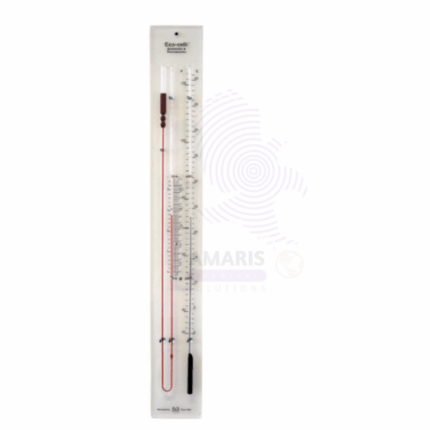
Barometer Tubes
Barometer Tubes are precision glass tubes used in barometers to measure atmospheric pressure. These tubes are typically filled with mercury or other suitable liquids and are sealed to allow accurate pressure readings based on liquid column height. Barometer tubes are essential components in meteorological instruments and laboratory equipment for pressure measurement and environmental monitoring. Manufactured with high-quality, clear glass, they provide durability, clarity, and accurate fluid displacement for precise readings.
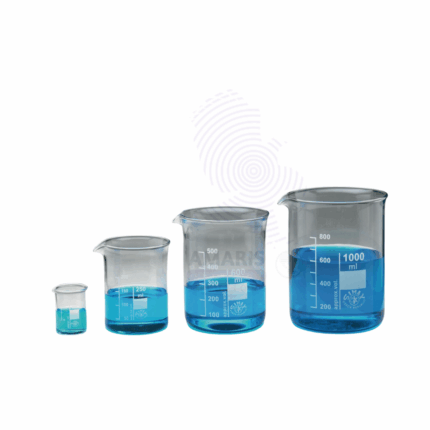
Beaker Simax
Beaker Simax is a high-quality borosilicate glass laboratory container renowned for its excellent thermal shock resistance, chemical durability, and mechanical strength. Manufactured by Simax, this beaker is ideal for mixing, heating, and holding liquids in laboratory and industrial environments. It can withstand sudden temperature changes without cracking, making it suitable for heating, cooling, and chemical processing. The clear glass body features graduated markings for approximate volume measurement.

Borosilicate Glass Tubings
Borosilicate Glass Tubings are high-quality glass tubes made from borosilicate material, known for excellent thermal resistance and chemical durability. These tubes are used extensively in laboratories and industries for transporting gases and liquids, conducting experiments, and fabricating custom glass apparatus. Their high resistance to thermal shock and chemical corrosion makes them ideal for harsh lab environments and industrial processes. Available in various diameters and lengths, these tubings can be cut or bent to suit specific experimental setups.
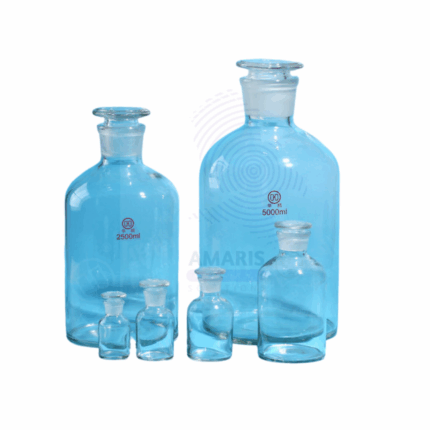
Clear laboratory reagent bottles
Product Description
Clear Laboratory Reagent Bottles are high-quality, transparent containers designed specifically for storing, transporting, and dispensing chemical reagents and solutions in laboratory settings. Made from durable borosilicate glass or high-grade plastic materials, these bottles offer excellent chemical resistance, clarity for easy identification of contents, and airtight sealing to maintain reagent integrity. They are essential in analytical, biochemical, and industrial laboratories for safe and organized chemical storage.
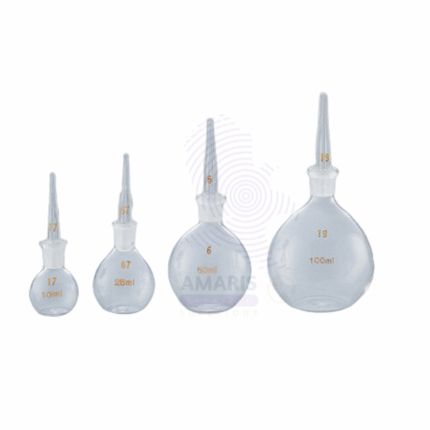
Density Bottle
The Density Bottle is a precision glassware device used for determining the density of liquids by measuring a known volume and mass. Typically made from high-quality borosilicate glass, the bottle features a tight-fitting stopper with a capillary hole to allow excess liquid to escape, ensuring volume accuracy. It is commonly used in laboratory settings for experiments in physical chemistry, materials science, and industrial quality control processes. The device provides a reliable method for comparing the density of various substances with high repeatability.

Distillation Apparatus
Distillation Apparatus is a laboratory setup designed for the separation, purification, and collection of liquid mixtures based on differences in boiling points. It typically consists of components such as a distillation flask, condenser, receiving flask, and connecting tubes, often made from chemically resistant borosilicate glass. This apparatus allows controlled heating, vaporization, condensation, and collection of volatile substances. Widely used in chemical laboratories, pharmaceutical manufacturing, food and beverage processing, and research, the distillation apparatus is essential for isolating pure liquids, removing impurities, and analyzing complex mixtures.
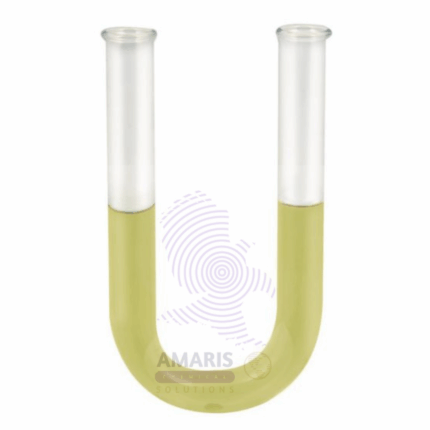
U tube lab glass
U Tube Lab Glass is a precision-crafted glass apparatus shaped in a U-form, widely used in laboratory experiments involving fluid dynamics, pressure measurement, and gas collection. Made from chemically resistant borosilicate glass, the U Tube offers excellent durability, thermal resistance, and clarity for easy observation of liquids and gases. It is commonly employed in physics, chemistry, and engineering labs for manometer setups, fluid flow experiments, and pressure differential measurements. The design ensures accurate and reliable results while withstanding the rigors of routine laboratory use.

U Tube Lab Glass With Side Arms
U Tube Lab Glass with Side Arms is a specialized U-shaped borosilicate glass apparatus featuring additional side arms for fluid or gas connections. Designed for laboratory experiments involving pressure measurement, fluid flow, and gas displacement, this device offers enhanced versatility. Made from chemically resistant, durable glass, it withstands temperature fluctuations and chemical exposure. The side arms facilitate easy integration with tubing and other equipment, enabling complex experimental setups in physics, chemistry, and engineering labs. It is widely used in manometer applications, vacuum experiments, and fluid dynamics research.












