Preservatives(food)
 Flavors
 Acidulants
 Sweeteners
 Antioxidants
 Colorants(food)
 Nutraceutical Ingredients (food)
 Nutrient Supplements
 Emulsifiers
 Collectors
 Dust Suppressants
 Explosives and Blasting Agents
 Flocculants and Coagulants
 Frothers
 Leaching Agents
 pH Modifiers
 Precious Metal Extraction Agents
 Antioxidants(plastic)
 Colorants (Pigments, Dyes)
 Fillers and Reinforcements
 Flame Retardants
 Monomers
 Plasticizers
 Polymerization Initiators
 Stabilizers (UV, Heat)
 Antifoaming Agents
 Chelating Agents
 Coagulants and Flocculants
 Corrosion Inhibitors
 Disinfectants and Biocides
 Oxidizing Agents
 pH Adjusters
 Scale Inhibitors( water)
 Antioxidants(cosmetic)
 Emollients
 Oils
Oils Carrier Oills
 Essential Oils
 Humectants
 Preservatives
 Surfactants(cosmetic)
 Thickeners
 UV Filters
 Fertilizers
 Soil Conditioners
 Plant Growth Regulators
 Animal Feed Additives
 Biostimulants
 Pesticides (Herbicides, Insecticides, Fungicides)
 Active Pharmaceutical Ingredients (APIs)
 Excipients
 Solvents(pharmaceutical)
 Antibiotics
 Antiseptics and Disinfectants
 Vaccine Adjuvants
 Nutraceutical Ingredients (pharmaceutical)
 Analgesics & Antipyretics
 Analytical Reagents
 Solvents(lab)
 Chromatography Chemicals
 Spectroscopy Reagents
 microbiology-and-cell-culture-reagents
 Molecular Biology Reagents
 Biochemical Reagents
 Inorganic and Organic Standards
 Laboratory Safety Chemicals
 Specialty Laboratory Chemicals(Special Laboratory Equipment)
 Demulsifiers
 Hydraulic Fracturing Fluids
 Scale Inhibitors(oil)
 Surfactants(oil)
 Drilling Fluids
 Dyes and Pigments
 Bleaching Agents
 Softening Agents
 Finishing Agents
 Antistatic Agents
 Admixtures
 Waterproofing Agents
 Sealants and Adhesives
 Curing Compounds
 Concrete Repair Chemicals
 Anti-Corrosion Coatings
 Surfactants(cleaning)
 Builders
 Enzymes
 Solvents (Cleaning)
 Fragrances (Cleaning)
 Electronic Chemicals
 Catalysts
 Lubricants
 Photographic Chemicals
 Refrigerants
 Automotive chemicals
 Pyrotechnic Chemicals
 Biodegradable Surfactants
 Bio-based Solvents
 Renewable Polymers
 Carbon Capture Chemicals
 Wastewater Treatment Chemicals
 Pigments
 Solvents(paint)
 Specialty Coatings
 Binders/Resins
 Additives
 Driers
 Anti-Corrosion Agents
 Functional Coatings
 Application-Specific Coatings
 Leavening Agents
 Dough Conditioners
 Flour Treatments
 Fat Replacers
 Decoratives
 Preservatives(baking)
 Plasticizers & Softeners
 Reinforcing Agents
 Adhesion Promoters
 Vulcanizing Agents
 Antidegradants
 Blowing Agents
 Fillers & Extenders
 Accelerators & Retarders
🧪 D(+) Maltose Extra Pure: Definition, Purity Standards, and Industrial Applications

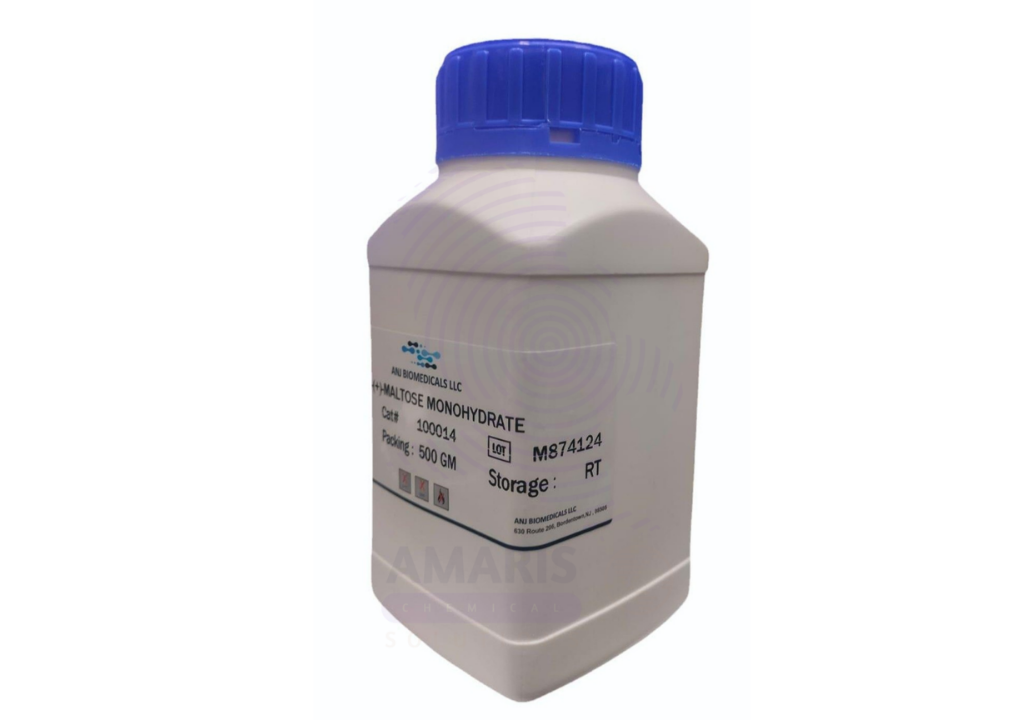
By Amaris Chemicals – Trusted Supplier of High-Purity Laboratory & Pharmaceutical Reagents 🔬
In the chemical supply industry, purity is not merely a specification—it is a guarantee of performance. At Amaris Chemicals, we recognize that the success of pharmaceutical formulations, microbiological assays, and biotechnological processes depends entirely on the quality of raw materials used. ✅
This article provides a comprehensive overview of one of our core products: D(+) Maltose Monohydrate, Extra Pure. We define the product, explain the significance of the Extra Pure grade, and detail its major industrial applications. 📘
🔍 What is D(+) Maltose Extra Pure?
D(+) Maltose Monohydrate (C₁₂H₂₂O₁₁ • H₂O) is a disaccharide composed of two D-glucose units joined by an α-1,4 glycosidic bond. Commonly referred to as malt sugar, it is produced through the enzymatic hydrolysis of starch and is found naturally in germinating cereals. 🌾
The designation “Extra Pure” indicates that the product has undergone advanced purification processes—including multiple recrystallization steps, ultrafiltration, and rigorous quality control—to remove impurities such as higher saccharides, trace metals, pyrogens, and microbial contaminants. 🧼
This grade conforms to NRC (National Research Council) specifications and is suitable for sensitive biochemical and pharmaceutical applications. 🏭
📋 Key Specifications of D(+) Maltose Extra Pure
Appearance: White, free-flowing crystalline powder
Solubility: Freely soluble in boiling distilled water; slightly soluble in alcohol; insoluble in chloroform and ether 💧
Clarity: A 5% w/v solution in boiling distilled water is clear and colorless 👁️
Assay: Not less than 99.0% on anhydrous basis
Loss on Drying: 5.0 – 6.5% (corresponding to monohydrate form)
pH (5% solution): 4.5 – 6.5
Microbiological Quality: Passes test for absence of pathogenic organisms 🧫
Storage: Store below 30°C in a tightly closed container, protected from light 📦
🏭 Major Applications of Extra Pure Maltose
1. 💉 Vaccine and Biopharmaceutical Manufacturing
The single most critical application of Extra Pure Maltose is in the production of vaccines and injectable biologics. Due to its non-pyrogenic nature and high purity profile, maltose serves as an effective cryoprotectant during lyophilization, a stabilizer for live attenuated viral strains, and an excipient in parenteral formulations. ❄️🦠💊
Pharmaceutical manufacturers require raw materials that are endotoxin-free and batch-to-batch consistent. Amaris Chemicals supplies maltose that meets the stringent raw material standards of GMP-certified production facilities. 🏥
2. 🧫 Microbiological Culture Media
Maltose is a selectively fermentable carbohydrate widely incorporated into differential and diagnostic culture media. Key applications include Phenol Red Maltose Broth for the identification and differentiation of gram-negative bacteria based on acid production, fungal cultivation media where maltose promotes sporulation and biomass yield in yeasts and molds, and selective isolation of enteric pathogens. 🧪🍄🦠
The Extra Pure grade eliminates background fermentation caused by contaminating sugars, thereby ensuring accurate and reproducible microbiological results. 📊
3. 🧬 Biochemical Research and Molecular Biology
In research and academic laboratories, D(+) Maltose Extra Pure is employed in protein purification systems, specifically as a ligand in maltose-binding protein (MBP) affinity chromatography. It is also used in enzyme kinetic studies as a substrate for alpha-glucosidase and beta-amylase, as well as in metabolic research investigating carbohydrate transport in prokaryotic and eukaryotic systems. 🧪⚗️🔬
High-purity carbohydrates are essential for experimental reproducibility, a cornerstone of credible scientific research. 📚
4. 🍺 Brewing and Industrial Fermentation
Maltose is historically and industrially significant as the primary fermentable sugar in brewing. In modern industrial biotechnology, purified D(+) Maltose is used to standardize fermentation feedstocks, produce low-calorie and light beers, and cultivate high-density yeast cultures for baker’s yeast production. ⚙️🍻🥖
The absence of inhibitory by-products in Extra Pure maltose ensures optimal fermentation kinetics and consistent product quality. 📈
5. 💊 Pharmaceutical Excipients and Formulations
Beyond biologics, maltose functions as a bulking agent in lyophilized parenteral products, a tonicity adjuster in intravenous formulations, and a sweetening vehicle in pediatric and geriatric oral liquids. 💊💧🍼
Its excellent solubility, low hygroscopicity, and chemical stability make it a preferred carbohydrate excipient in modern drug delivery systems. ✅
6. 🍬 Food and Confectionery Industry
In food manufacturing, maltose is valued for its mild sweetness, heat stability, and resistance to crystallization. It is used in the production of hard candies, jellies, baked goods, and as a humectant in processed foods. Its low glycemic index also makes it an attractive alternative sweetener in functional food formulations. 🍭🍰🥨
🎯 Conclusion
D(+) Maltose Extra Pure is far more than a simple sugar. It is a high-value specialty chemical that enables innovation in vaccine development, clinical diagnostics, fermentation science, food processing, and advanced pharmaceutical manufacturing. 🚀
When your process demands uncompromised purity, consistency, and regulatory compliance, Amaris Chemicals delivers. 🛡️