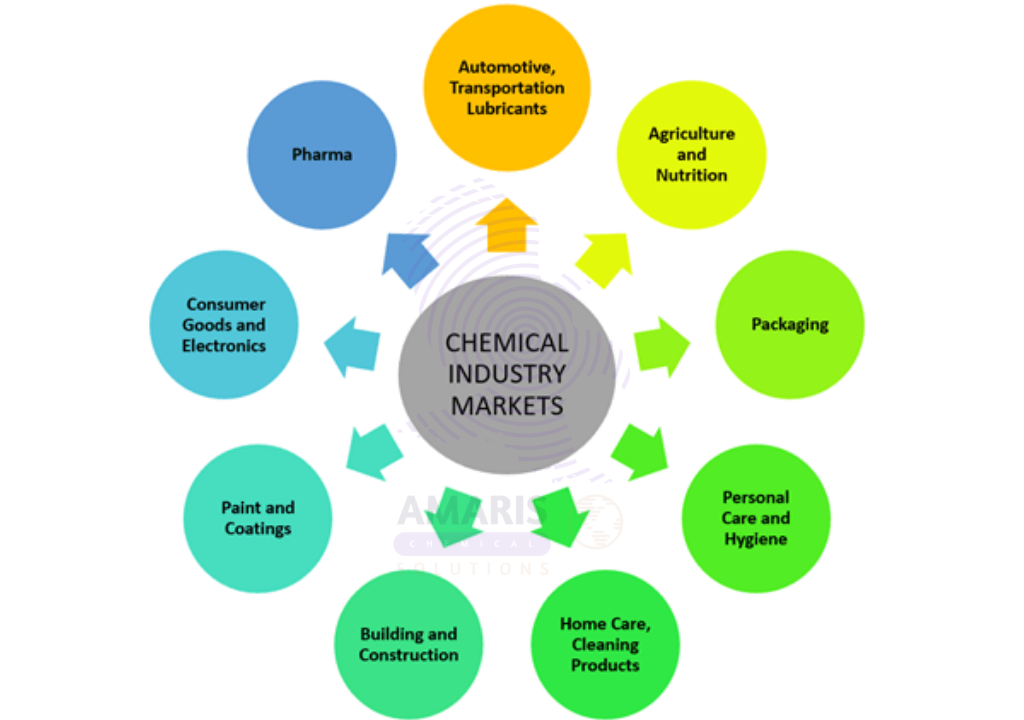
Preservatives(food)
 Flavors
 Acidulants
 Sweeteners
 Antioxidants
 Colorants(food)
 Nutraceutical Ingredients (food)
 Nutrient Supplements
 Emulsifiers
 Collectors
 Dust Suppressants
 Explosives and Blasting Agents
 Flocculants and Coagulants
 Frothers
 Leaching Agents
 pH Modifiers
 Precious Metal Extraction Agents
 Antioxidants(plastic)
 Colorants (Pigments, Dyes)
 Fillers and Reinforcements
 Flame Retardants
 Monomers
 Plasticizers
 Polymerization Initiators
 Stabilizers (UV, Heat)
 Antifoaming Agents
 Chelating Agents
 Coagulants and Flocculants
 Corrosion Inhibitors
 Disinfectants and Biocides
 Oxidizing Agents
 pH Adjusters
 Scale Inhibitors( water)
 Antioxidants(cosmetic)
 Emollients
 Oils
Oils Carrier Oills
 Essential Oils
 Humectants
 Preservatives
 Surfactants(cosmetic)
 Thickeners
 UV Filters
 Fertilizers
 Soil Conditioners
 Plant Growth Regulators
 Animal Feed Additives
 Biostimulants
 Pesticides (Herbicides, Insecticides, Fungicides)
 Active Pharmaceutical Ingredients (APIs)
 Excipients
 Solvents(pharmaceutical)
 Antibiotics
 Antiseptics and Disinfectants
 Vaccine Adjuvants
 Nutraceutical Ingredients (pharmaceutical)
 Analgesics & Antipyretics
 Analytical Reagents
 Solvents(lab)
 Chromatography Chemicals
 Spectroscopy Reagents
 microbiology-and-cell-culture-reagents
 Molecular Biology Reagents
 Biochemical Reagents
 Inorganic and Organic Standards
 Laboratory Safety Chemicals
 Specialty Laboratory Chemicals(Special Laboratory Equipment)
 Demulsifiers
 Hydraulic Fracturing Fluids
 Scale Inhibitors(oil)
 Surfactants(oil)
 Drilling Fluids
 Dyes and Pigments
 Bleaching Agents
 Softening Agents
 Finishing Agents
 Antistatic Agents
 Admixtures
 Waterproofing Agents
 Sealants and Adhesives
 Curing Compounds
 Concrete Repair Chemicals
 Anti-Corrosion Coatings
 Surfactants(cleaning)
 Builders
 Enzymes
 Solvents (Cleaning)
 Fragrances (Cleaning)
 Electronic Chemicals
 Catalysts
 Lubricants
 Photographic Chemicals
 Refrigerants
 Automotive chemicals
 Pyrotechnic Chemicals
 Biodegradable Surfactants
 Bio-based Solvents
 Renewable Polymers
 Carbon Capture Chemicals
 Wastewater Treatment Chemicals
 Pigments
 Solvents(paint)
 Specialty Coatings
 Binders/Resins
 Additives
 Driers
 Anti-Corrosion Agents
 Functional Coatings
 Application-Specific Coatings
 Leavening Agents
 Dough Conditioners
 Flour Treatments
 Fat Replacers
 Decoratives
 Preservatives(baking)
 Plasticizers & Softeners
 Reinforcing Agents
 Adhesion Promoters
 Vulcanizing Agents
 Antidegradants
 Blowing Agents
 Fillers & Extenders
 Accelerators & Retarders
Marble Chips Extra Pure: The Versatile Mineral Powering Laboratories, Water Treatment, and Industrial Applications 🧪⚪🌍


At first glance, marble chips may appear to be simple white stone fragments, but in reality, Marble Chips Extra Pure are an incredibly useful material in scientific laboratories, water treatment systems, construction processes, and industrial applications. Their high purity, chemical stability, and natural mineral composition make them valuable in many technical fields.
Derived from natural marble rock, these chips consist primarily of calcium carbonate, a compound widely used in chemistry and industry. When refined and processed to an extra pure grade, marble chips become suitable for controlled laboratory environments and specialized industrial uses where quality and consistency are essential.
Today, Marble Chips Extra Pure serve as a reliable resource in laboratories, educational institutions, filtration systems, and manufacturing processes, demonstrating how a natural mineral can support modern science and technology.
What Are Marble Chips Extra Pure?
Marble chips are small fragments produced from high-quality marble stone, carefully processed and cleaned to remove impurities. The “extra pure” grade indicates that the chips contain a very high concentration of calcium carbonate (CaCO₃) with minimal contamination.
This purity is particularly important in scientific and technical applications because impurities can affect chemical reactions, experimental accuracy, or industrial processes.
Marble chips typically appear as white or off-white solid granules and are known for their durability, chemical stability, and slow reactivity with acids. These characteristics make them ideal for controlled experiments and filtration processes.
Because they are a natural material with consistent chemical composition, marble chips are widely used where predictable reactions and stable performance are required.
Essential Role in Laboratory Experiments 🔬
One of the most common uses of Marble Chips Extra Pure is in chemistry laboratories. Students, teachers, and researchers frequently use marble chips in demonstrations and experiments involving acid–carbonate reactions.
When marble chips react with acids such as hydrochloric acid, they release carbon dioxide gas, making them perfect for experiments that demonstrate gas evolution, reaction rates, and fundamental chemical principles.
For example, marble chips are commonly used to study:
• Reaction rate experiments
• Carbon dioxide generation
• Acid neutralization reactions
• Basic chemical reaction demonstrations
Because the extra pure grade contains minimal impurities, the results of experiments remain accurate, repeatable, and reliable, which is essential in educational and research environments.
Importance in Water Treatment 💧
Marble chips are also widely used in water treatment and filtration systems. Calcium carbonate plays an important role in neutralizing acidic water, making marble chips useful in correcting water pH levels.
In water filtration units, marble chips slowly dissolve when exposed to acidic water, releasing calcium carbonate that helps balance the pH and improve water quality.
This process is especially valuable in systems designed to treat acidic groundwater, rainwater harvesting systems, and industrial water supplies. By stabilizing pH levels, marble chips help protect pipes, equipment, and water distribution systems from corrosion.
Their durability and gradual dissolution make them a long-lasting and cost-effective solution for water treatment applications.
Industrial Applications ⚙️
Beyond laboratories and water treatment, Marble Chips Extra Pure play a role in various industrial processes. Calcium carbonate is an important raw material in many industries, and marble chips provide a natural and reliable source.
Industries may use marble chips for:
• Chemical processing and raw material preparation
• Manufacturing of calcium-based compounds
• Glass and ceramic production
• Neutralizing acidic industrial waste streams
Because marble chips are chemically stable and easy to handle, they are suitable for use in both small-scale laboratory environments and large-scale industrial operations.
Educational Importance 📚
In schools and universities, marble chips are one of the most commonly used materials for teaching fundamental chemistry concepts. Their visible reaction with acids makes them perfect for classroom demonstrations.
Students can easily observe how chemical reactions produce gases, how reaction rates change with surface area, and how carbonate compounds behave in acidic conditions.
These experiments help learners understand core principles such as:
• Chemical reactions and gas evolution
• Surface area effects on reaction rates
• Carbonate chemistry
• Stoichiometry and reaction analysis
Because of their safety and simplicity, marble chips remain a classic and essential material in chemistry education worldwide.
Environmental and Practical Benefits 🌱
Marble chips offer several environmental and practical advantages. Since they are derived from natural stone, they are widely available and relatively sustainable when responsibly sourced.
Their long lifespan and gradual chemical activity make them suitable for applications that require slow, controlled reactions. Additionally, their non-toxic nature allows them to be used safely in educational environments and water treatment systems.
These qualities make marble chips a reliable material for industries and laboratories seeking effective yet environmentally responsible solutions.
Why Choose the Extra Pure Grade?
Purity is critical in both scientific and industrial applications. Marble Chips Extra Pure provide a high level of calcium carbonate with minimal impurities, ensuring consistent performance in experiments and technical processes.
This quality level ensures:
• Reliable chemical reactions
• Accurate experimental results
• Consistent industrial performance
• Reduced contamination risks
For laboratories and industries that depend on dependable materials, extra pure marble chips provide an excellent balance of natural composition and refined quality.
Final Thoughts
Although they may seem simple, Marble Chips Extra Pure play a surprisingly important role across multiple industries. From supporting chemical education in laboratories to stabilizing water quality and assisting industrial processes, this natural mineral continues to demonstrate its versatility and value.
Their chemical reliability, natural origin, and wide range of applications make marble chips an essential material in modern science and industry. Whether used in a laboratory experiment, a water filtration system, or a manufacturing process, Marble Chips Extra Pure remain a dependable and effective solution.
As industries continue to grow and scientific research advances, materials like marble chips will continue to support innovation, education, and environmental management around the world. ⚪🧪🌍